


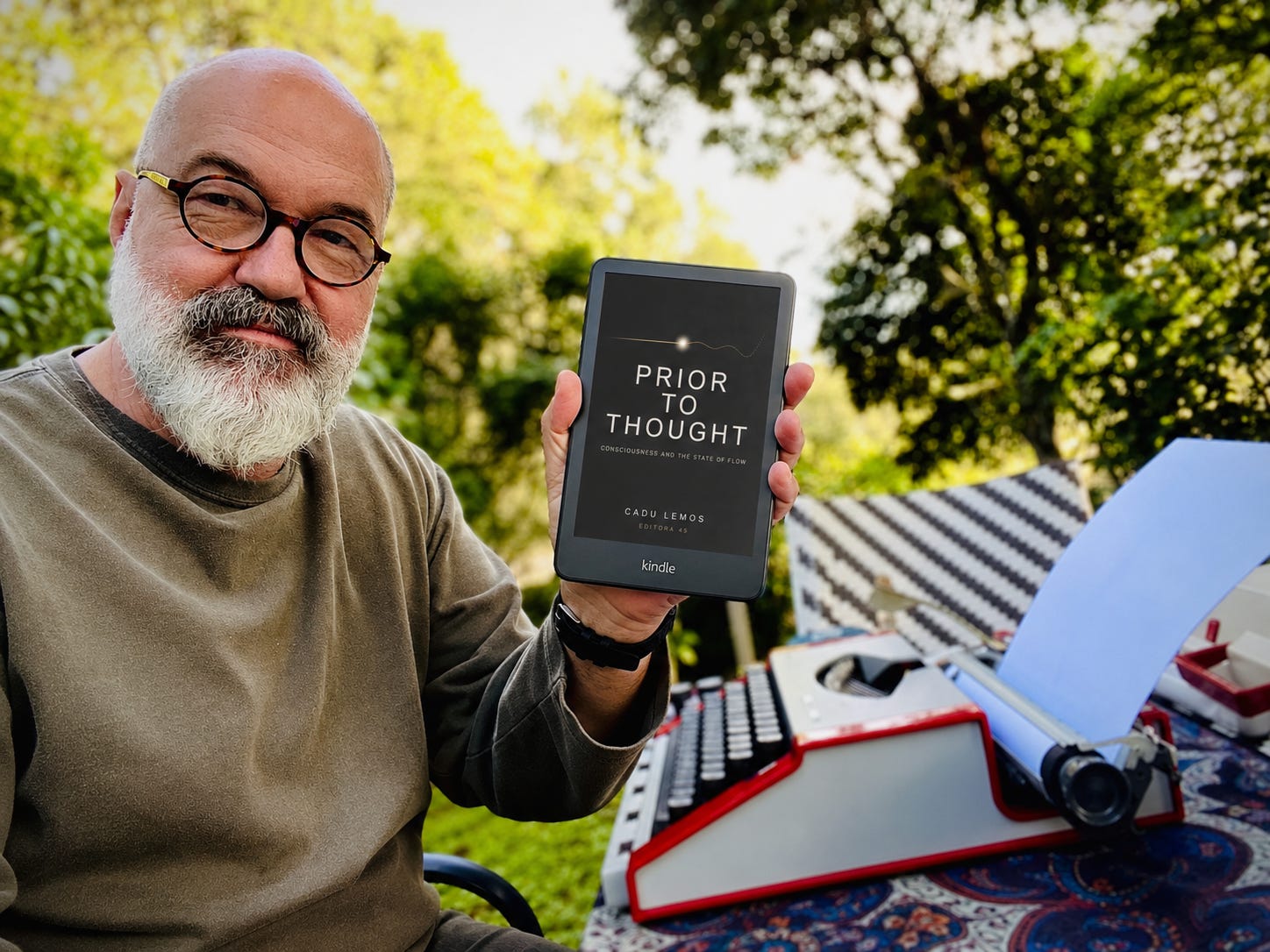
Almost a year ago, Antes do Pensar came out in Brazil. I had written it on a typewriter, one chapter at a time, without an outline, without a plan for what it was going to become. Each session started from the same place: a blank page, a typewriter of my own age, and the deliberate absence of everything else. I did not know then how fitting that would turn out to be. A book about the state that happens when thinking gets out of the way, written in the one condition that reliably made thinking get out of the way.
What I did know was the question at the center of it, that shoul not be “how do you reach flow,” the way most books on the subject are framed. That question always seemed to me to start from the wrong place, as if flow were a destination you navigate toward rather than a condition that surfaces when you stop obstructing it. The question I kept returning to was simpler and harder: what is already present before the thinking begins?
That question is what Prior to Thought is about. And in a few days, to mark the first anniversary of the Portuguese edition, it arrives in English.
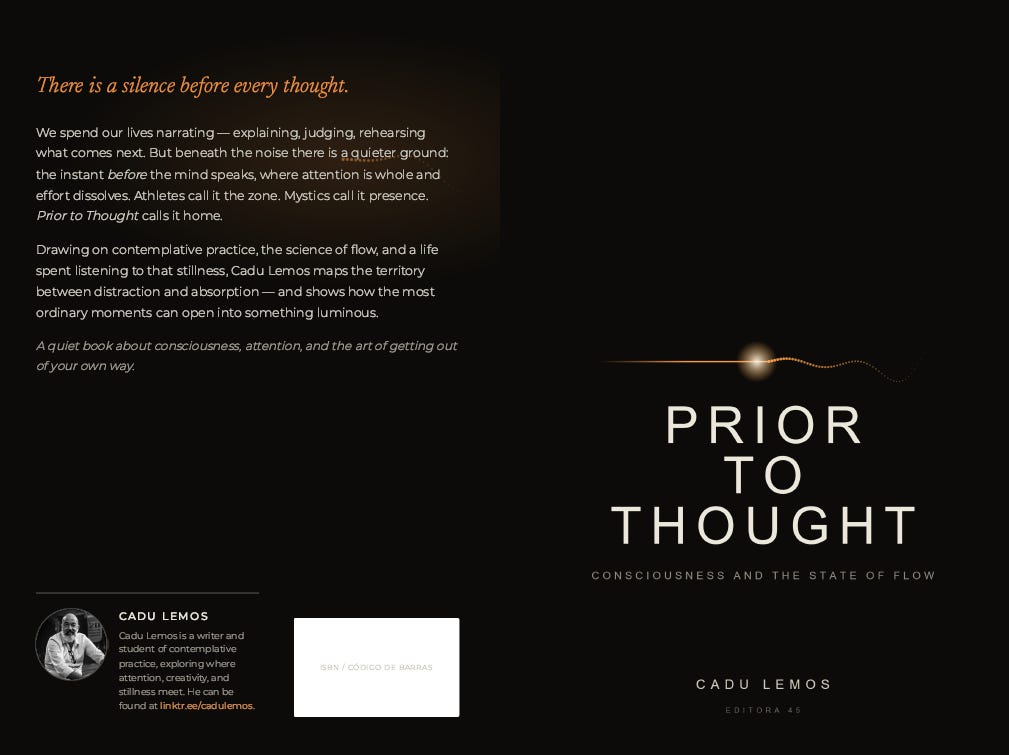
The book opens with consciousness, because flow without it is just a performance metric. There is the consciousness that perceives the world linearly, that says “I am here, doing this, now.” And there is a deeper dimension, what I call Consciousness with a capital C, the silent presence that holds everything without reacting to any of it. When we enter the state of flow, these two dimensions meet. The sense of separation between the person and the action dissolves, and what remains is pure, unobstructed presence.
Bernardo Kastrup gives this the most precise image I have encountered: personal identity as a whirlpool in a river. The whirlpool appears distinct, has a recognizable shape, seems separate from the water around it. It never was. The whirlpool and the river are the same thing in two different expressions. Flow is the momentary experience of that truth.
This is also why I spend considerable time in the book on what flow is not. It is not a productivity hack. It is not a neurochemical trick for optimizing output. The corporate world has been enthusiastic about instrumentalizing flow for exactly the results it cannot produce that way. The moment you try to manufacture non-separation, you guarantee more separation. The pressure logic that drives most high-performance cultures is the same logic that prevents the state from emerging.
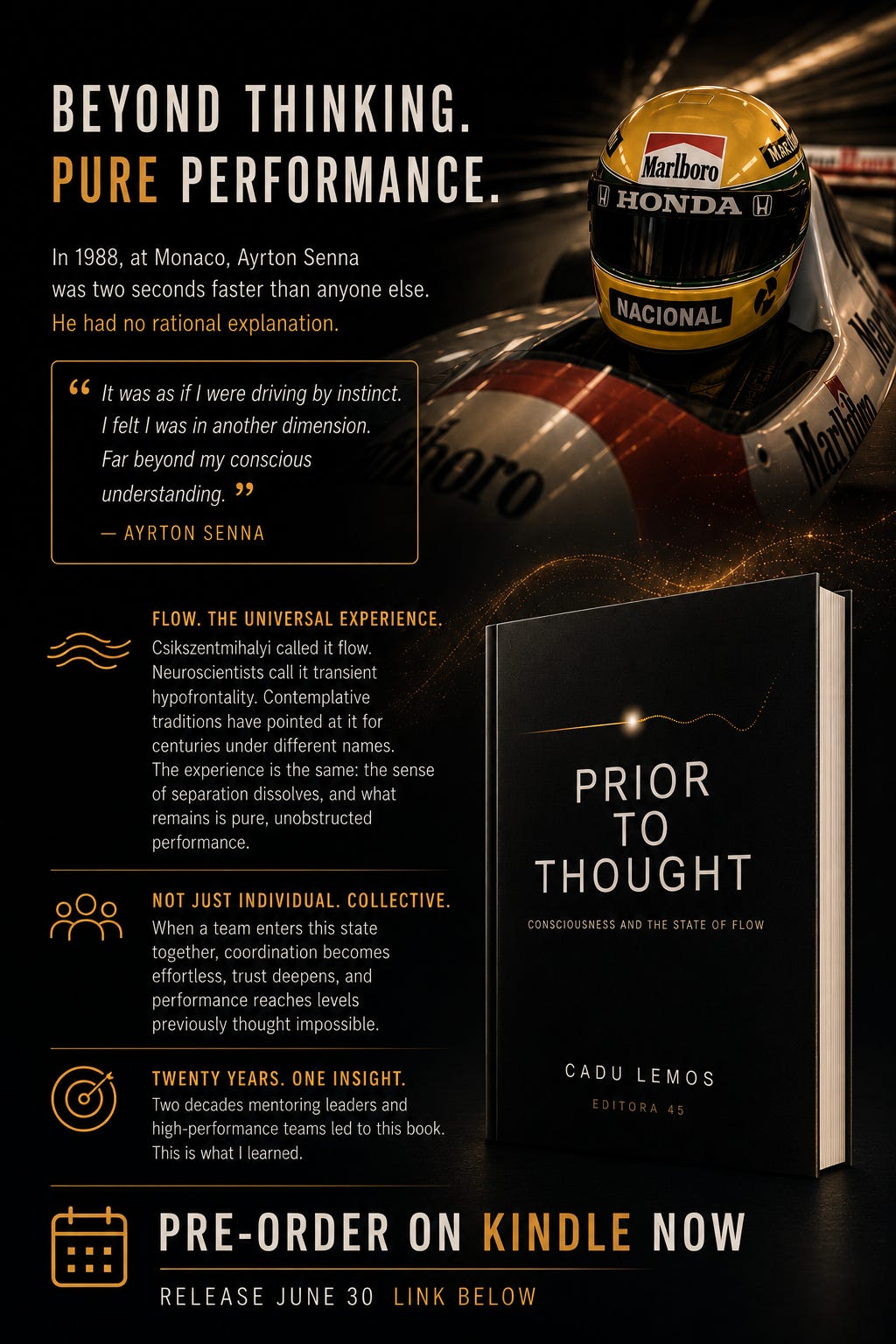
The neuroscience matters here, and I cover it in some detail. When you enter flow, the prefrontal cortex, the region responsible for self-monitoring, judgment and the running commentary the mind keeps about itself, significantly reduces its activity. This is transient hypofrontality. The inner critic does not get suppressed. It simply is not running. What Senna experienced at Monaco in 1988, two seconds faster than everyone with no rational explanation, what Michael Jordan had in the first half of a game where he shrugged at his coach as if to say “I cannot explain this either,” what Lolo Jones lost the moment she thought about improving her stride and clipped the next hurdle: the same neurological state. The inner critic went quiet and something deeper took over.
The practical question is not how to force this. Forcing it is one of the most reliable ways to prevent it. The real question is what conditions stop fighting it.
The book offers those conditions without turning them into a system. Rituals rather than habits. The balance between challenge and skill that Csikszentmihalyi identified as the threshold where flow becomes accessible. The role of conscious breathing in shifting from sympathetic to parasympathetic dominance. The difference between a scattered mind and genuine presence, which turns out to matter more than almost anything else we spend our attention on.
The second half of the book moves into collective flow, which I think is where the real frontier is. Individual flow is remarkable. Collective flow, the state in which a group begins to operate as a single organism, is something else entirely. The Formula 1 pit stop record is 1.80 seconds. Fourteen people, four tires, no verbal communication during the stop itself. What makes that possible is not practice alone. It is what happens when individual mental models switch off and the group finds a shared rhythm beneath them.
Google’s Project Aristotle studied 180 teams for two years and found that the strongest predictor of high performance had nothing to do with technical skill or individual talent. It had everything to do with psychological safety: the belief that the environment is safe for taking interpersonal risk. Amy Edmondson had named this a decade before the Google study confirmed it. It is the neurological prerequisite for collective flow. Without it, the state cannot emerge. With it, the results look like what surgical teams describe as “operating as a single organism,” what Navy SEAL units call “the switch,” what jazz musicians experience when the improvisation stops being five people playing and becomes one thing moving.
Most organizations never get there because they mistake coordination for synchrony. They are not the same thing. Coordination is planned. Synchrony arises.
The book ends where it begins, with consciousness, with the question of what exists before thought. The closing pages draw the line between flow and non-duality explicitly. Both involve the temporary dissolution of the sense of separation between observer and observed. Both require the same inner condition: the analytical mind quiet enough for presence to fill the space it vacates. The Zen archer who releases the arrow without thinking “aim better” is not performing a technique. He has stopped performing altogether. What remains is the bow, the arrow, the target and the space between them as a single undivided movement.
That is the experience I have been trying to point at for twenty years in my work with leaders and teams. Prior to Thought is the most complete attempt I have made to name it.
The English edition is available for pre-order now on Kindle, with release on June 30.
If you have colleagues, friends or readers who engage with consciousness, flow, leadership or contemplative thought and read in English, this book was written for them. I would be grateful if you passed it along.
Uma observação para os leitores brasileiros: esta edição de O Psiconauta, foi escrita para os leitores da seção *The Psychonaut* que carrega meus ensaios em inglês. Estou enviando-a a todos os assinantes porque muitos de vocês têm conexões e contatos internacionais que leem nesse idioma.
O link para pré-venda funciona em todo o mundo. A edição em português de “Antes do Pensar” continua disponível no mesmo link da Amazon tanto no Kindle como em papel.
Obrigado por um ano de leitura juntos.

Just pre-ordered it! Will there also be an explanation as to how one would pronounce this fascinating last name? Csikszentmihalyi. 😊
Please find a reference which is very much about this topic:
http://www.consciousnessitself.org
The Dawn Horse Press published a book which was specifically about the topic of The Five Reality Teachings - it is titled Notice This - The Five Reality Teachings
One brief section refers to Mandukya Upanishad which provided a very early analysis of the three common states of Waking Dreaming & Sleeping