


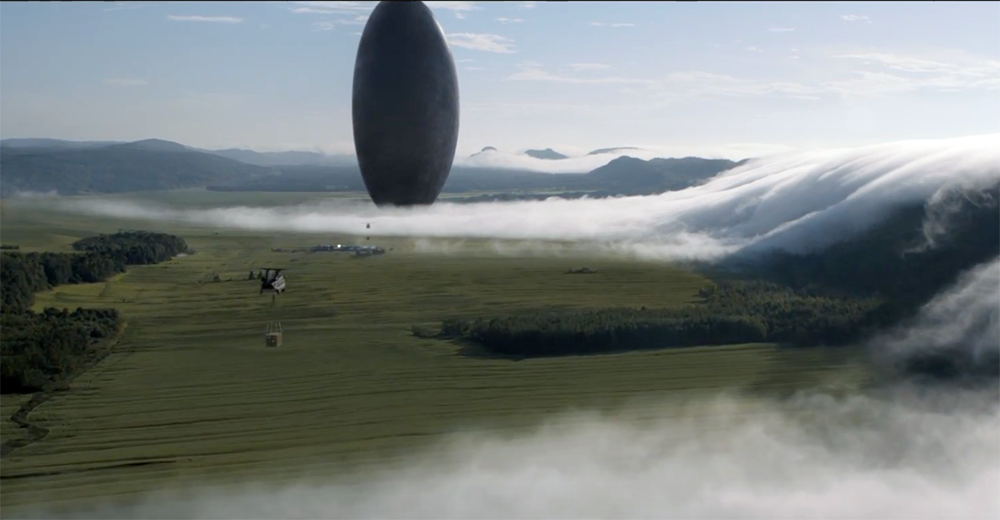
I rewatched Arrival (Denis Villeneuve, 2016) almost ten years later, and the experience unfolded in a completely different way. There was no surprise in the story — the film was the same, even though some might say that its interpretation changes over time. But no, this time it was I who had changed. And profoundly so. Especially in the way I felt what the film proposes.
My attention, as I revisited the story, was no longer concentrated in that usual point behind the eyes, where we tend to organize life as if someone were in there running the show. The gaze felt more diffuse, lower, supported by the whole body, with the breath accompanying the images. The film was not simply being watched; it was resonating in a place that had now become available.
Perhaps that is why Arrival awakens an emotion so difficult for me to explain (it is one of my three favorite movies ever) and, at the same time, so easy to recognize. The emotion does not arise from the narrative, the suspense, or attachment to the characters. It emerges before the story takes shape — a direct, almost physical recognition of something that was already there. The remarkable director Denis Villeneuve does not force understanding, does not lead the viewer by the hand, does not resolve anything. He creates a space in which certain mental structures begin to relax on their own, especially the one that sustains our relationship with time and language.
What I saw and felt this time
In the film, language ceases to be merely an instrument for exchanging information and begins to reveal its deeper role: organizing experience, giving continuity to memory, sustaining the sense of identity and our understanding of the world. The reference to the “Sapir-Whorf Hypothesis,” or linguistic relativity, is a fundamental point in the film’s argument.
As for time, when seen from this perspective, it appears as a functional arrangement — useful for operating in the world — that notion of line and continuity. Yet it is insufficient to explain what is alive now. The emotional impact comes from this subtle shift, when perception recognizes that life does not happen in sequence; it was narrated that way so the character could remain coherent.
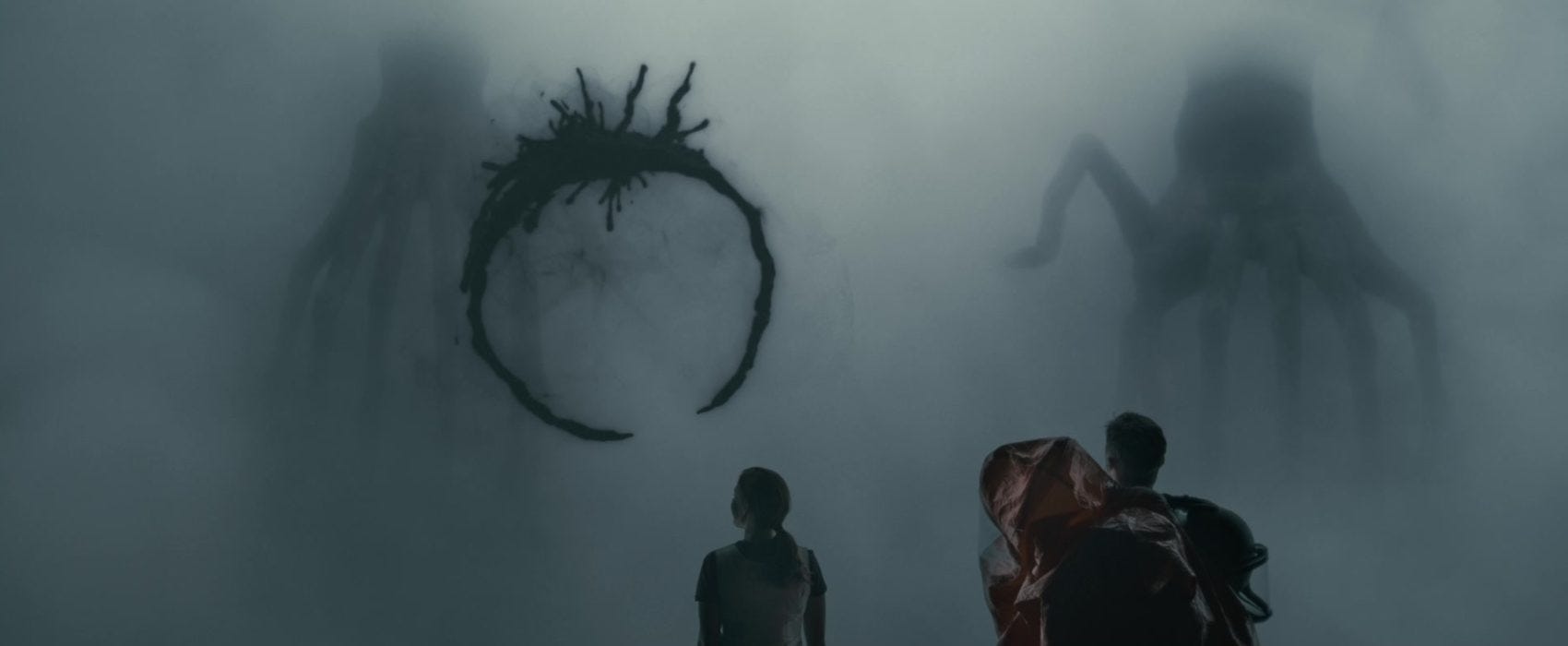
This recognition does not usually appear as a clear idea. It arrives more like a feeling — a gentle pressure in the chest, a pause in the inner hurry, a kind of emotion without a defined object. It is the same quality of presence that shows up when we listen to instrumental music, watch someone sleeping deeply, or follow a sunset without the need to comment on it or post it on Instagram. Arrival sustains this state through long silences and cinematography that favors space and interval, refusing to over-explain. The gaze slows down and, with it, thought loses the impulse to step forward with explanations and interpretations.
Rewatching the film, it became difficult to ignore the contrast between this silent field and the kinds of issues that usually capture us as a humanity: fear of the other, struggles for control, urgency to predict scenarios, incessant attempts to secure safety in a territory that has never offered guarantees.
While these concerns repeat themselves, the film points to something much simpler and, for that very reason, rarely considered — the suggestion that Consciousness is not located inside the body nor confined to the mind, created by neural activations. It is the wider field in which bodies, minds, stories, and expectations appear and disappear, without effort and without a fixed center.
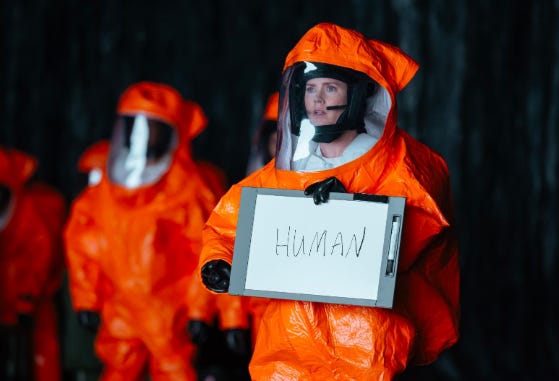
What makes Arrival so moving is that it does not soften this realization, nor does it protect the identity we believe ourselves to be. The experience of the linguist portrayed by Amy Adams makes it clear that understanding time does not eliminate pain, that seeing farther does not prevent loss, that loving means welcoming the entire experience with everything it carries — and it carries a lot. The emotional weight arises precisely at this point, when the fantasy of control loses its support and life presents itself as it is, whole, with no possible editing. Remaining there requires more honesty than strength.
It is deeply human to notice that the Consciousness watching the film is of the same nature as the Consciousness sustaining every form that appears on the screen — whether the characters, the two heptapod beings (Abbott and Costello 😉), or the silence between one scene and another. When this perception touches, even briefly, experience is no longer organized in terms of inside and/or outside. The film is not in front of someone on a screen; it happens in the same field where thoughts, sensations, and emotions arise.
Perhaps Arrival provokes so much reflection — and even some discomfort — because, as it shifts our relationship with time, language, and identity, something very intimate begins to lose its contours. This does not happen abruptly or spectacularly, but with the naturalness of something that has always sustained experience and that, for a moment, ceases to be taken as a character.
The question I asked myself and repeat here
In that silent moment that remains after the credits, when there is no longer a story to follow nor meaning to interpret, what exactly continues looking?
The time we live in exposes the limits of a perception centered on a separate “self,” and conflicts, polarization, excessive consumption, and inequality appear as expressions of the same basic confusion about who looks, who decides, and from where life is being conducted.
“Well, you know, that’s just, like, your opinion, man.”
— The Big Lebowski
One of my favorite movies, very touching. An inspiration to think that maybe not everything is as we "simply" see it with our very own eyes.
Such a trip, this movie.