



What exists between the man who boards and the one who disembarks isn’t time, it’s the man himself.
In 1941, T.S. Eliot wrote, in The Dry Salvages 1, that you aren’t the same person who left that station, nor the one who’ll disembark at the final destination. Heraclitus of Ephesus 2 claimed that a man never bathes in the same river twice. The reason is twofold: the river is no longer the same, because the water that passed doesn’t return, and the man isn’t the same either, because the previous instant already changed him in some way he probably didn’t notice. Two thinkers, radically different eras and contexts, pointing at the same fact we keep ignoring with impressive competence.
Cellular regeneration happens continuously in the human body, not every seven years, as science once assumed. But that’s just the tip of a much bigger iceberg: what we call “I” is an uninterrupted flow of experiences, from the most automatic to the most conscious, and it presumes a continuity that goes beyond body and mind. Gurdjieff called these apparatuses “machines.” Bernardo Kastrup 3 prefers the image of whirlpools: vortices that emerge from the same water and, for a while, seem to have a life of their own. The water, though, is one.
Breathing happens. The heart beats. The stomach digests. None of these processes depends on intention, planning, or effort, and any deliberate interference in some of them ends in collapse.
Sight happens, the heart beats, until one day it doesn’t beat anymore. None of that goes through any decision of ours.
When I look with any honesty at what I actually control, the list is much shorter than my ego would like to admit. There’s a doing that happens without a doer, an observation without an observer, this isn’t metaphor, it’s simply what direct experience reveals when we stop trying to overlay concepts and rationalizations onto it.
What’s curious is what we do with this perception when it shows up. Instead of letting the recognition of the flow dissolve the illusion of a fixed, separate center, we reverse the movement: we reinforce the boundary, stiffen the identity, and start operating as if this imagined “I” were not only real but sovereign. The notion of separation, and I insist it’s a notion, not a reality, produces consequences we know well: we feel above animals, above nature, above the planet, and naturally, above other human beings. Especially those humans who, by some convenient criterion, we’ve decided aren’t quite as equal to us. Impossible not to think of Orwell 4 here. The belief that there’s an isolated, sovereign “I” underlies everything we produce that’s most destructive, from the hierarchies that justify exploitation to the wars we call necessary.
I keep thinking about when this self-deception reached its current scale. A hypothesis that’s followed me for years: it happened the moment our nomadic ancestors found a place good enough to stay. By putting down roots, they also put down property, and with it came fences, boundaries, borders. The logic of “mine” and “yours” became the seed of all subsequent separation. Another equally plausible possibility: separation took hold when figures like Buddha, Jesus, Lao Tzu, Rumi, and others who lived without the illusion of a separate self had their words hijacked by those who presented themselves as intermediaries of the divine, turning teachings about the dissolution of the ego into instruments of control and hierarchy.
The two processes probably reinforced each other. The result is plain to see.
The world has gone back to organizing itself around authoritarianism and closure, and that strikes me as less a deviation than the most honest expression of what we’ve never stopped being.
The collective ego operates by the same logic as the individual ego: the greater the threat to its fiction, the more rigid the boundary it raises. Trump and the crowd around him, the ayatollahs, Orbán, and the recent wave of “leaders” riding this same tide aren’t anomalies, they’re symptoms. They reflect the political crystallization of a much older, much more intimate belief: that there’s an “us” that needs defending from a “them,” that identity only holds together through exclusion, that security only exists behind walls, literal or symbolic. Fascism isn’t born of ideology, it’s born of fear, and fear is born of the illusion of separation taken to its institutional limit.
Hannah Arendt observed, in Eichmann in Jerusalem, from 1963, that totalitarianism thrives where people lose the capacity to think, to put themselves in another’s place, to inhabit any perspective beyond their own. What she called the “banality of evil” is, seen from another angle, the banality of separation: the inability to perceive that the other isn’t an existential threat, but the same water forming a different whirlpool. What Heraclitus saw in the river, we refuse to see in each other.
We reap what we sow, quite faithfully. For centuries, we planted the conviction that we’re separate entities competing for scarce resources in a hostile world. Contemplative philosophy pointed in another direction, but modernity pushed it to the margins, treated as boutique spirituality while civilization built itself on the exact opposite. Now we’ve reached the point where the cost of this belief becomes impossible to ignore: borders, walls, denialism, climate collapse treated as a matter of opinion. Separation became foreign policy.
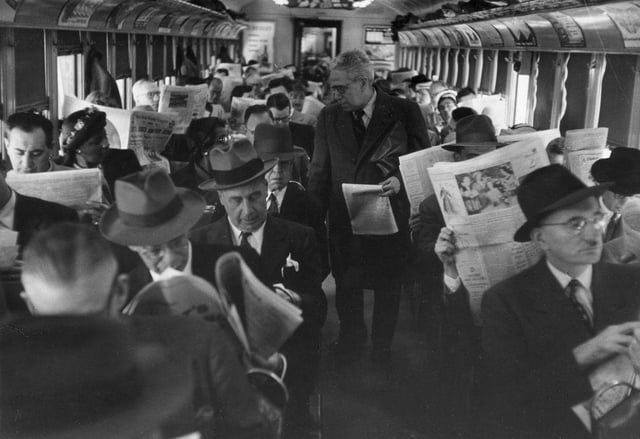
I’m just not sure if we need a shock to snap out of this, or if the shock is already happening and we’re still on the train, reading the newspaper, not noticing that we aren’t the same people who boarded.
“It’s, well, you know, that’s just, like, your opinion, man.”
— The Big Lebowski
Thank you for reading The Psychonaut!
No author owns what they write; they are merely the translator of the silence that precedes it. Writing was the way I found to explore who we are when the mind grows still. Each text is born from this silent movement of consciousness trying to recognize itself in form. Sometimes words emerge; other times, only the space between them. I don’t write to explain anything; I write to remember. Fiction, science, and everyday life are merely pretexts. What speaks from behind is the same silence that reads.
I keep everything here free and easily accessible, with no strings attached. If you find it useful, the best way to support this project—besides subscribing—is through a restack, a recommendation, or by sharing the post—it makes a huge difference.
"Four Quartets" is a set of four poems by T.S. Eliot, published between 1935 and 1942, considered his masterwork. The poems, "Burnt Norton," "East Coker," "The Dry Salvages," and "Little Gidding," explore time, memory, spirituality, and mysticism. Each poem is structured in five stanzas and meditates on a specific geographic location.
Heraclitus of Ephesus's (c. 540–470 BC) famous line, often rendered as "no one can step into the same river twice," symbolizes his philosophy of becoming and constant flux (panta rei). It means everything in the world is constantly changing; neither the river is the same (the waters flow on), nor is the person who steps into it (who has also changed). The River Metaphor: Heraclitus, a pre-Socratic philosopher, observed nature and saw movement as essential to life. The river's waters pass and are never the same, symbolizing the continuous transformation of the cosmos. Human Change: upon returning to the river, the person has also changed, whether physically or in their experiences. The human being is part of this continuous flow of "rebirth." His statement teaches about accepting impermanence and valuing the present moment. This reflection, frequently cited in philosophy, highlights the unity of opposites and the eternal change of reality.
Bernardo Kastrup is a contemporary philosopher and thinker, known for defending analytic idealism, which proposes that reality is fundamentally mental. With doctorates in philosophy and computer engineering/AI, he argues that the physical world is a representation of consciousness, not the other way around. Main points: Analytic Idealism — Kastrup argues that the physical world is a manifestation or "projection" of a universal mind. Academic background — holds a doctorate in Philosophy and one in Computer Engineering (Artificial Intelligence). Works — author of several books, including Why Materialism Is Baloney and The Idea of the World. Sites: bernardokastrup.com / essentiafoundation.org
Animal Farm, by George Orwell, is a satirical fable about the corruption of power. Animals on a farm rebel against their human owner to create an egalitarian society, but the pigs take control, becoming dictators worse than the original humans, culminating in the line: “All animals are equal, but some animals are more equal than others.”