Outsourced Intelligence
What happens to a mind that learns to ask outwardly for what can only be felt inwardly

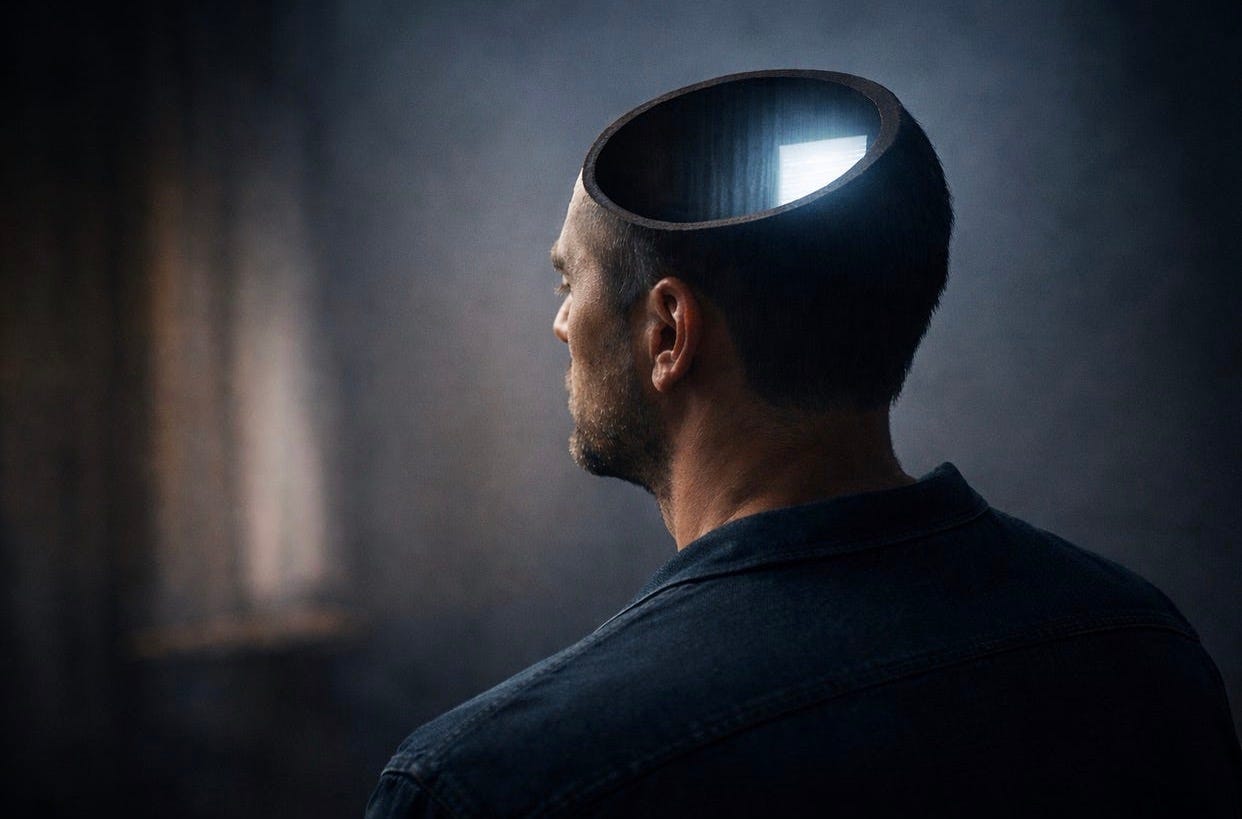
Recently, some of the questions people are asking AI have come into focus, in growing volumes, and they are worth noting for what they reveal about an ongoing absence we still can’t quite explain: “Why do I feel empty?” Alongside it come others of similar weight: “How do I know if someone loves me?”, “How do I make friends as an adult?”, “How do I become the person I want to be?” These are questions that, not long ago, circulated among friends, in letters, in therapy sessions, or in the quiet of the night with someone trusted. Now they arrive in a text box. And the box responds, available at three in the morning, without judgment and without delay.
I understand the appeal. There is a certain comfort, genuine, in receiving an answer that sounds reasonable for something that hurts. The response that comes from outside with such fluency that it resembles empathy and understanding touches the one who asks, and it is worth observing what that is. A real convenience.
Decades ago, psychologist Mihaly Csikszentmihalyi documented what most people feel but few can articulate: the quality of subjective experience depends on the degree to which attention is genuinely invested in what one is doing. When attention is fully present, time disappears and effort feels effortless. The flow state. When it jumps from stimulus to stimulus without ever truly landing, the experience diminishes. The person is there, but lives with the persistent sense that life is happening somewhere else.
What screens have done over the past fifteen years, and what AI is now accelerating, is the industrialization of that fragmentation. Instant response trains attention to expect immediate gratification and to avoid the discomfort that precedes any real understanding, the discomfort of not knowing yet, the suspension of meaning before it appears. This interval, which is precisely where original thought lives, has been systematically eliminated as if it were a bug, when it may be the most essential function of the conscious mind.
“Why do I feel empty?” is a question that requires, to be answered with any honesty, that the one asking remain with the emptiness long enough to perceive what it contains. AI cannot do that.
It can describe emptiness with clinical precision and offer well-researched perspectives, but it cannot create the silence necessary for the answer to arise from within. The answer about one’s own emptiness only exists from within, because this is structurally true: no one has access to your subjective experience except you.
The concrete risk, verifiable in the behavior of anyone willing to observe honestly, is that delegation becomes a habit before it is even recognized as delegation. A person begins by asking for dinner recipes and ends by asking for guidance on what to feel in difficult situations. The capacity to tolerate one’s own question without an immediate answer narrows, until asking inward feels slower and less reliable than asking outward. The mind learns that the answer is in the text box. And stops looking where the answer actually lives.
Sam Altman, Open AI CEO, has overtly said that he sees a future in which intelligence will be distributed as a public service, metered and accessible by subscription. He may be right about the business model, but there is a serious ambiguity in the use of the word intelligence there, because intelligence in the sense that matters for a life lived with presence, the ability to perceive what is happening in me now and to distinguish what I truly want from what I have been conditioned to want, that kind of intelligence is not something you subscribe to on a “Pro” plan.
What is at stake here, without dramatizing it, is the muscle of presence, which strengthens with use and atrophies when it is not engaged, exactly like any other muscle. Each time attention truly lands on something difficult and remains there without escaping to the next stimulus, something takes shape. Each time a difficult question receives a quick external answer before it can mature internally, something dissolves. The sum of these micro-choices over time is the quality of the relationship a person has with themselves.
The answer to one’s own emptiness only exists where the question hurts.

“Yeah, well, you know, that’s just, like, your opinion, man.”
— The Dude
Thank you for reading The Psychonaut!