



There is a division that precedes all others. It predates politics, religion, economics, and conflict between nations or neighbors. A separation so fundamental that we carry it as if it were the very structure of reality, believing that the world has always been this way and that there is no other way to exist. It is the inevitable and atavistic division between subject and object, between the “I” that observes and the “world” that is observed, between what is inside and what is outside. Everything we call a human problem, when you dig deep enough, has its roots in this misconception.
A young child is not born with this division already in place. Research in developmental psychology suggests this, but anyone who has ever sat in silence with a baby just a few months old knows it intuitively: the one who looks has not yet completely separated the act of looking from the object being looked at. The world and the being who perceives the world still share a permeability, a continuity that has not yet been severed by language and concept. Then the knife comes in. Gradually, the process of socialization, of naming things, of identity construction, erects a kind of membrane between the “self” and the rest. When this membrane is established, the problem begins, because a separated subject is a fearful subject.
Fear is the logical and inevitable consequence of separation. If there is an isolated “self,” delimited and with defined boundaries, then that self can be threatened, diminished, destroyed. It must defend itself, expand, accumulate, and compare itself to others. It must win, or at least not lose. Competition is not a human trait; it is arithmetic: where there are two separate entities, a hierarchy is possible, and where a hierarchy is possible, there is anxiety.
The separated subject lives in a permanent, low-intensity war with everything it perceives as “other”, whether another human being, a circumstance, or the very passage of time that threatens to dissolve it.
Look closely enough at any conflict, and you will find this mechanism at work. War between countries is the amplified version of what happens between two people in an argument, which is the amplified version of what happens within a single mind when it resists what is happening. The structure is always the same: an “I” that perceives itself as separate and threatened, reacting to preserve its boundary. The content and scale change, but the mechanism is identical. Imperialism, racism, misogyny, tribalism of every kind - all of these are technologies of separation, ways of making the boundary between the “self” and the “other” sharper and more justified, and therefore more permanent.
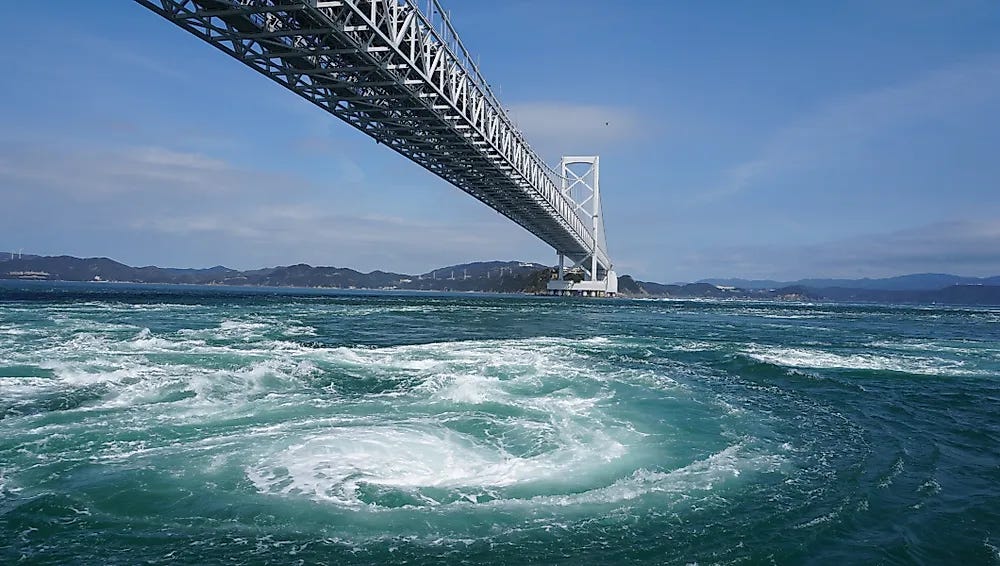
What non-duality observes (and this is evident in Vedanta, Buddhism, Taoism, Zen, certain interpretations of Christian and Islamic mysticism, and philosophy) is the realization that this separation is a construct, not a discovery; curiously, this understanding is also beginning to emerge in quantum physics and the cognitive sciences. The subject did not find itself as something distinct from the world. The subject was fabricated, slowly, by layers of thought, language, and repeated experience, until the fabrication seemed as solid as the furniture in the room. Bernardo Kastrup 1 describes individual consciousness as a whirlpool in a river: it has form, it has its own movement, it can be identified and named, but there is no moment when it ceased to be water. The separation is functional, not ontological. Useful for navigating the world, catastrophic when taken as absolute truth.
That is precisely where the misconception lies. It is not the existence of an individual perspective, a localized point of view, or a particular subjective experience that is real (and worth living to the fullest). The misconception lies precisely in believing that this perspective is an independent entity, a “self” that exists on its own, separate from the consciousness that permeates it and the world that constitutes it. When this happens, the whirlpool forgets it is a river and wastes all its energy trying to sustain itself, trying to grow, trying not to dissolve, in a struggle that is, by definition, endless.
Most human suffering has this texture. Chronic anxiety, the feeling of inadequacy, the compulsion for external validation, the difficulty of being present without the mind constructing protective narratives, the addiction to busyness (ah, the glamour of saying “I’m so busy”...) to avoid feeling the terrifying emptiness—all of this is the experience of a person who believes they are separate and needs to sustain themselves within that separation. The problem lies in the structure that organizes each person’s specific contents, that imaginary center around which everything orbits and which, when you look directly at it, has the consistency of a shadow.
The most direct question there is, the one that non-dual traditions ask in different ways, is simply: who is this “I”? Or what is this “I”? These are not abstract philosophical questions; it is a real investigative technique, performed now, in this very moment. When you look for the observer, what do you find? There are thoughts, sensations, perceptions, images, sounds, the weight of the body on the chair, the breath that continues on its own. But the “I” that should be coordinating all of this, the central subject that grammar presupposes in every sentence, that one, when you look directly at it, slips away, dissolves, always one step behind the gaze. The observer and the observed have never been as separate as everyday experience suggests.
I write about this here on The Psychonaut because I believe, with the conviction that comes from repeated observation, that this recognition is the only thing that changes anything at its root. Political reforms, technological advances, cultural changes, all of these have value, but nothing will reach the source as long as the separate subject continues to operate as an unquestionable premise. The ecological crisis is the relationship of the subject to nature treated as an object of use. The political crisis is the relationship between subjects who recognize no shared substance. The mental health crisis is the cost of maintaining a separate identity in a world that, at no fundamental level, sustains that separation. I am not proposing dissolution, passivity, or indifference to the world. I am not a nihilist. I am merely pointing out that there is a way of existing in which the individual perspective remains alive and functional, but the existential terror that comes from absolute separation begins to lose its power.
When the whirlpool remembers that it is a river, it does not stop spinning; it continues to move, continues to have form, continues to be identifiable. It just stops fighting against the water. The subject is the problem that resolves itself when you stop looking for someone to solve it.
“Yeah, well, you know, that’s just, like, your opinion, man.” - The Big Lebowski
Oh, great, you write in English too!
This is wonderful! I do hope you share more in English! Thank you!