

The man who never believed in borders
There is more than one way into the same territory.

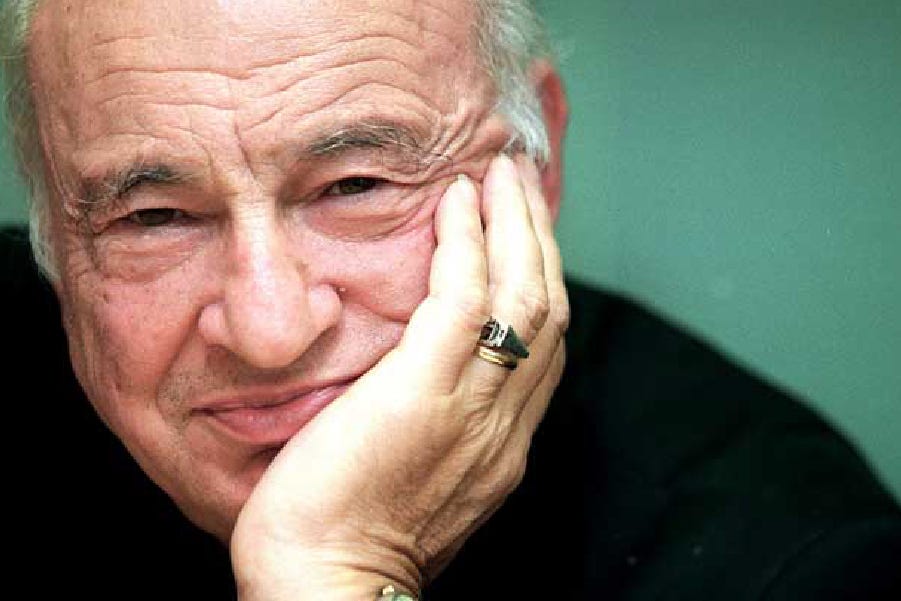
Edgar Morin devoted decades to constructing—with the rigor of someone who takes the matter seriously—an argument that any five-year-old intuitively feels before learning to dismiss it: that you and the world are not separate entities that meet from time to time. He called this “complex thinking”; he could have called it something else—the name was never the point.
There is a sentence in The Method that has stayed with me ever since I came across it: “The human being is at once physical, biological, psychic, cultural, social, and historical.” Read quickly, it seems like an academic list. Read carefully, it breaks down the wall. Morin is saying that you are the universe examining itself, that the line between the cosmos and the human is a conceptual artifice with no correspondence in reality, that the separation we feel between ourselves and nature is a functional construct we take for granted. He spent eighty years building the academic proof of what reveals itself on a quiet afternoon, and what interests me most in the entire work is precisely this point of arrival.
Morin had a concept he called “reconnecting”: intelligence that separates, specializes, and compartmentalizes loses the ability to see the whole. For him, the central pathology of modern thought was precisely this: the amputation of the perception of totality in the name of analytical efficiency. The well-made mind, his ideal, was one that could reconnect what had been artificially divided. But reconnecting presupposes that there was a connection before. And he knew that. The entire architecture of complex thought rests on this intuition: separation is the secondary event, not the primary one.
Most of us have lived for decades believing the opposite—that we are autonomous individuals who occasionally connect with the external world, that nature and consciousness belong to distinct orders of existence, and that life is the relationship between these two entities. Morin dedicated his life to showing that this description is a functional illusion and a cognitive trap. The cosmos did not produce human beings as one produces an artifact separate from the factory. Life emerged from matter, consciousness emerged from life, and in each emergence a novelty appeared without the previous one disappearing. We are stardust that has developed the capacity to ask ourselves what we are. There is no rupture in this chain.
What Morin did not say, at least not in those terms, is that this perception can be direct. That it does not require the six volumes of “The Method”, sociology, systemic biology, or epistemological constructionism. He arrived at it through decades of intellectual work; others arrive through the body, through silence, through the dissolution of the persona that believes it is in control, and the territory where everyone lands is the same.
What has moved me since last week, more than the death of a great thinker, is the image of a man who, at 104, still remained, in his wife’s words, attentive to the world, to others, and to the great human challenges. Attentive and present until the end, without the comfort of a closed system. This is the stance of one who knows that life is not a problem to be solved, but a phenomenon to be inhabited. And inhabiting requires presence.
Morin described himself as an “optimist of despair”: the graver the risk, the greater the possibility that a way out will emerge. Complex thought taken to the limit and, at the same time, non-duality without needing the term. The contradiction can be inhabited. The paradox is not a logical error; it is the most honest description of reality. To stop evading what is already here is the only thing that recognition demands.
Morin is gone. The absence of boundaries is not.
“Yeah, well, you know, that’s just, like, your opinion, man.”
- The Big Lebowski