


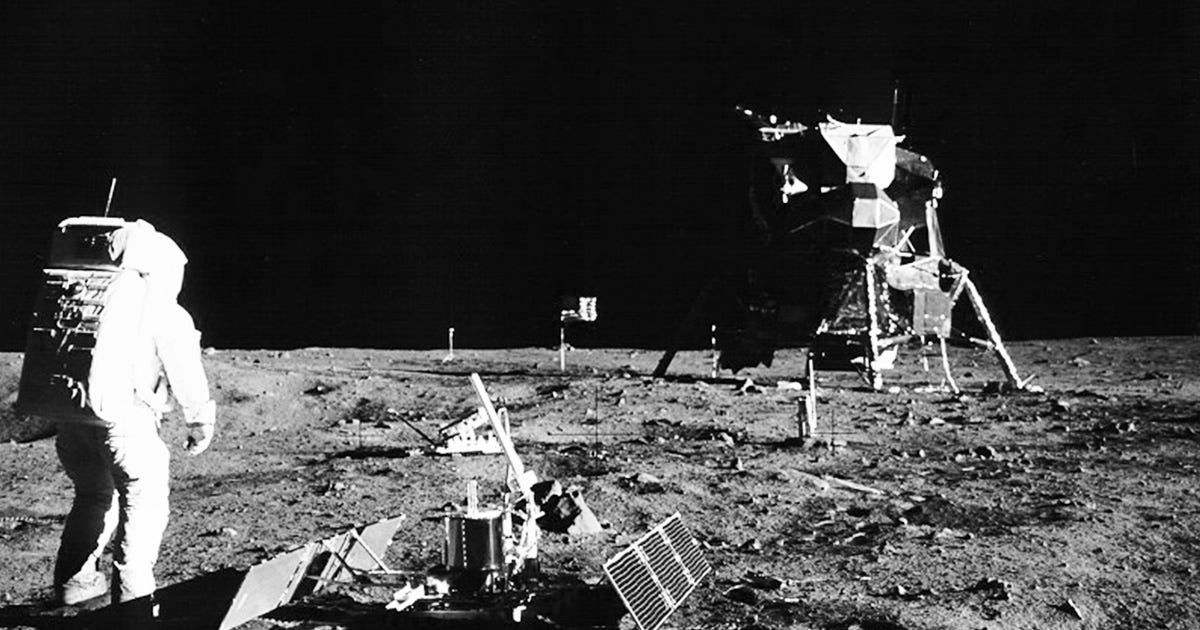
The launch of Artemis II brought back the emotion of that day, July 21, 1969, when I was seven years old. Now, after a long time, the first crewed flight to orbit the Moon is on. The ten-day mission will carry four astronauts, testing life support systems, navigation, and manual piloting capabilities before returning to Earth. They won’t land yet, but it’s a beginning. Last February marks 53 years since we last set foot on that place. From what we’re told, we will do so again next year, with Artemis III.
I grew up in a time of few conflicts, or at least that’s how it seemed.
I was born in 1962, and in the 1980s I started working. I was a witness to the greatest change humanity has undergone within my memory. The first had been at age seven, as I mentioned above.
The second, which struck us all, was September 11, 2001. Of course, before that I had already been affected by the Vietnam War, by Bosnia, by earthquakes, floods, and natural tragedies that swept the planet, but all of that carried a certain distance. September 11 was different. It was the first open fracture of the 21st century, something the generation before mine could scarcely have imagined. And more recently, the pandemic.
My point here is simple. Throughout history, countless tragedies and conflicts have shaped our lives, and without our noticing, they have offered us clues about our true nature. At some point, I began to consider that a different way was possible. Life could not be reduced to this.
Still a teenager, I began searching for answers. I joined study groups, circles of inquiry; I explored traditions such as Zen, Tao, Gurdjieff’s Fourth Way; I drew close to Hawaiian shamanism and the indigenous peoples of North America. I read, studied, practiced, went deeper - without ever forming a definitive bond with any of these lineages. I always knew, in a quiet place within me, that this was something no one could do for me. I learned, questioned, inquired, practiced. More than forty years of it. Until one day, something clicked.
What fell away was the illusion of separation. The clear, effortless perception that there had never been a “self” separate from everything else. The Consciousness that perceives these words, that hears the noise from the street, that feels the weight of the body in the chair — that Consciousness is not inside me, I am inside it. It has no address, no edges, it belongs to no one, because it is the very field in which everything appears, including the sensation of being someone.
The curious thing is that contemporary science is arriving at exactly this place, from the outside in. Donald Hoffman, cognitive scientist at MIT and professor at the University of California, spent decades demonstrating that our senses did not evolve to perceive reality - they evolved to keep us alive. What we see is not the world; it is a useful interface. The brain does not generate Consciousness; it filters it, reduces it, translates it into an operational version that allows us to cross the street without being run over.

Bernardo Kastrup a Brazilian-born Dutch philosopher and computer scientist who worked at CERN, the European Organization for Nuclear Research, takes this further with a lucidity that unsettles the academic establishment: matter does not produce Consciousness, Consciousness is what manifests as matter. The physical world is the outside of an universal mental process. Each of us is a temporary whirlpool in a river with no banks.
Does it sound like Eastern philosophy? Agreed. Except now it comes with equations, peer-reviewed articles, and considerable discomfort for those who still believe the brain manufactures the mind the way the pancreas manufactures insulin.
Every tradition I studied pointed toward this, each in its own language, and it took me decades to notice the obvious: there was never any distance between me and what I was seeking. The search itself was the only obstacle.
This perception, when it matures on a collective scale, will be the next and definitive shift in the human condition. Greater than the moon, greater than any war. The recognition that separation never existed. If it happens.
Today, I use the mind the way one uses a tool: analytically, on demand, when practical matters arise and call for some action. Like downloads. Beyond that, the mode is idle, available, with full attention on the present moment, on what surrounds me, registering each instant, each experience, grateful to be here. No gratitude journal, no meditation as a technique for quieting a mind that has already grown quiet on its own, because when the mind realizes that only what is here exists, it quiets itself.
Everything else is a projection: an idealized future that does not exist, or an imprecise memory insisting on generating sadness, anger, resentment. Imagination hijacks attention toward places that are not real.
Irrelevant.
Try, for even a short while, treating any thought as irrelevant, unimportant. See what happens, then tell me.
Who became sad? Who became angry? The ego. The mind.
Take one step back and observe this body/mind “unit” from a perspective that does not belong to it. Something is there, watching the thoughts and feelings that spring from those projections, from that imagination, from that always imprecise memory.
That something is you.
“Yeah, well, you know, that’s just, like, your opinion, man.”
- The Big Lebowski