The Nine Stops of Odysseus
Every island in the Odyssey hides an Enneagram profile and a different way of almost never coming home.

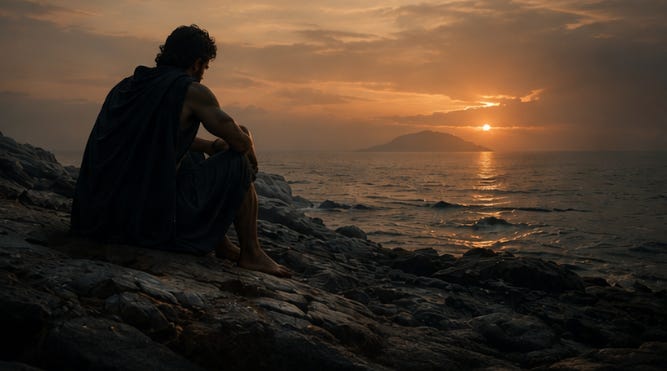
Christopher Nolan released a film about the Odyssey this year, and that brought Odysseus back into conversations among people who never read Homer at school. Good excuse to do what I’ve always wanted to do with this story: read it next to the Enneagram.
The two have a similar plot with a different vocabulary. Homer describes nine stops that delay a homecoming already guaranteed from the start. The Enneagram describes nine ways a person forgets who she is before any return is even possible. That’s no coincidence. They’re similar maps, one story told twice, with almost three thousand years between the versions.
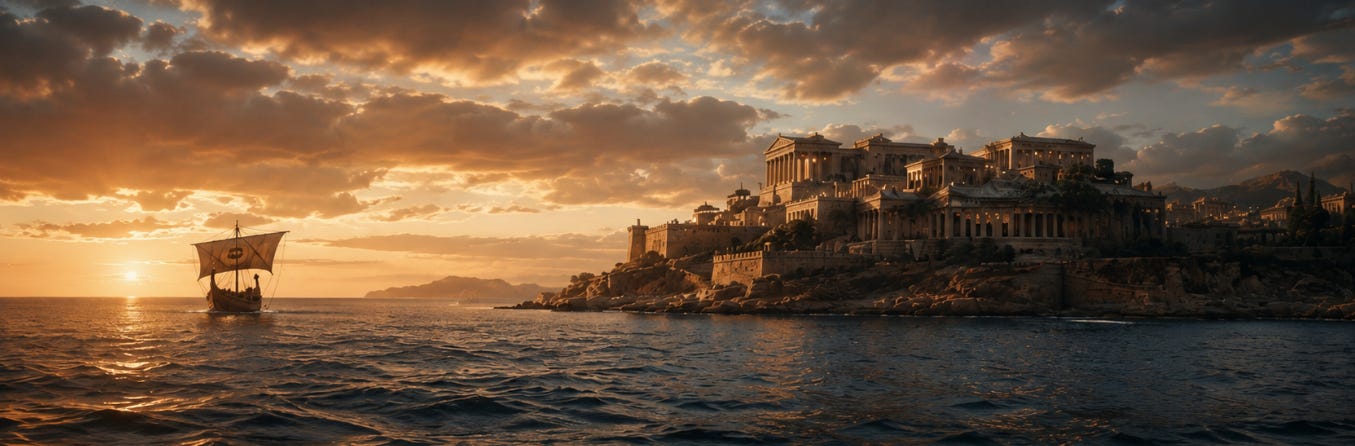
Odysseus spends ten years trying to get home after the war at Troy. Ithaca sits right there, visible for most of the voyage, and he still takes a whole decade to arrive. What delays the return goes past monsters and gods. A pattern repeats nine times, once at each stop, and the Enneagram has a name for every one of them.
The Enneagram of Psychological Types, the system I use in my work, describes nine profiles of people, each person fixed on a single one.
That fixation runs by itself most of the time, close to autopilot. I’ve worked with this system for years, inside what I call Fronteira Interior, as a tool for self-knowledge and for recognizing what never stopped being real. I use different names from the ones most people know, because I prefer words that say what each pattern does, past the label it carries in other schools. The map stays the same, tested for decades, and it explains each of Odysseus’s stops with a precision that gets uncomfortable.
Early in the voyage, Odysseus’s men reach an island where lotus flowers grow. Whoever eats the flower forgets everything, including the house waiting in Ithaca. They go mild, content, with no wish to leave. Odysseus has to drag his own men back to the ship, crying, against their will. The scene looks like peace. It isn’t. It’s forgetting. The Enneagram calls that Peace, type 9: the trap of disappearing from yourself to the point of forgetting even the wish to go home.
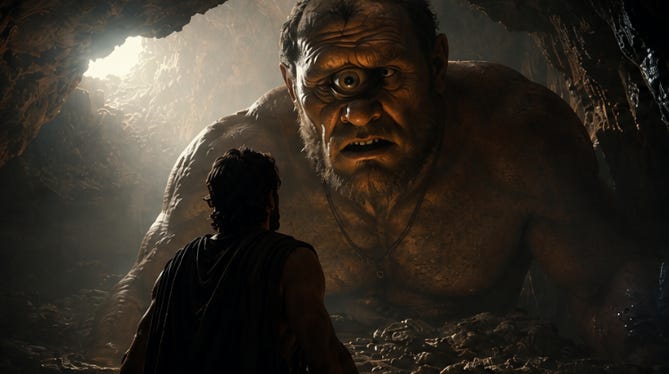
At the next stop, Odysseus gets trapped in the cave of the cyclops Polyphemus. To get out alive he invents a name, says he’s called Nobody, and when the cyclops screams in pain the neighbors ask who hurt him. The answer is Nobody, and nobody comes to help. Back on the ship, already safe, Odysseus shouts his own real name at the cyclops. He needs to be recognized as the man who blinded him, and that need costs him: Polyphemus asks his father, Poseidon, for revenge, and the sea that should have carried Odysseus straight home starts delaying that return for years. This is type 8, Power: the same force that saves him when he gives up his name almost destroys him when the name has to come back out loud.
From there they sail to the island of Aeolus, lord of the winds, who hands Odysseus a closed bag with every dangerous wind shut inside, leaving loose only the wind that blows straight to Ithaca. The coast of his own island is already on the horizon when the crew, figuring the bag holds hidden gold, opens it out of curiosity. The freed winds throw the ships back to the starting point. In the system the name for this is Pleasure, type 7: home gets lost in one instant of wanting more, right at the hour of arrival.
From the island of the winds, the fleet heads straight for the land of the Laestrygonians, cannibal giants. After the previous disaster, Odysseus learns to distrust and anchors his own ship outside the closed harbor while the rest of the fleet goes in to explore. The giants destroy the other eleven ships, sinking them with stones the size of boulders. Only Odysseus’s ship, anchored out of caution, escapes. This is type 6 of the Enneagram, Precaution: the same watchfulness that holds the fear up is what’s left afloat when everything else goes down.
Few survive to reach the island of Circe, the witch who turns half the crew into pigs with a drink. Before Odysseus gets near her, the god Hermes shows up and hands him a herb that cancels the magic, asking no effort or preparation of him. The protection doesn’t come from anything Odysseus stored or studied beforehand. It comes from outside, at the exact hour.
In the Enneagram this has a name: Planning, type 5. The trap of believing that only accumulated knowledge protects you, when what saves you sometimes arrives ready, without ever being asked for.
Circe sends Odysseus first to the world of the dead, after instructions from the prophet Tiresias, and then past the island of the sirens, whose song pulls sailors to certain death. Odysseus wants to hear the song without dying of it, so he orders the crew to plug their own ears with wax and tie him to the mast, tight, with no chance of working himself loose. He’s the only one who hears the whole song, and he survives exactly because he can’t act while he feels the melody. Type 4, Depth, is that: feeling everything, all the way through, without drowning in it, because the ropes hold from the outside while the desire passes.
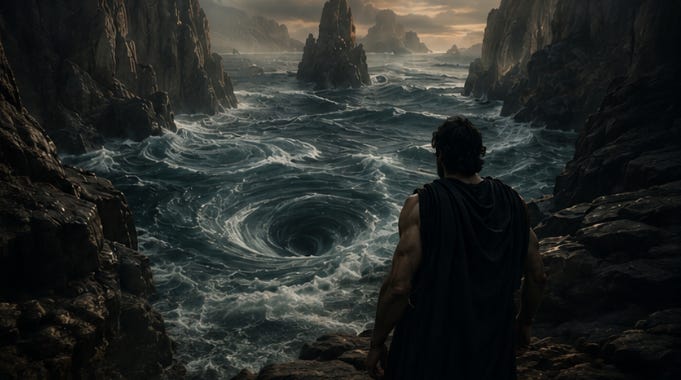
Right after comes the hardest choice of the entire voyage, a strait between two disasters: Charybdis, a whirlpool that swallows the whole ship, and Scylla, a six-headed monster that tears off one man with each head. Circe had already warned him that losing six was certain in that stretch, and Odysseus keeps the warning to himself, telling the crew nothing, set on keeping the ship rowing hard to the end. He loses the six men just as Circe predicted, watching each one ripped off the deck, without turning away. In the Enneagram this is type 3, Performance: holding the image of command changes nothing about the outcome, and the one real thing left to do is stay and witness the loss.
What’s left of the fleet wrecks soon after, and Odysseus spends seven years alone on the island of the nymph Calypso, who offers immortality and permanent comfort, everything a life could ask for, as long as he stays. He turns it down. He sits on the beach crying for an ordinary, mortal house that sits much farther away than any comfort Calypso offers. That’s Readiness, type 2, in the Enneagram: complete care isn’t the same thing as home, and a perfect life at another address is still exile.
After Calypso and before Ithaca comes the last stop: the island of the Phaeacians. They receive Odysseus, still a stranger and still nameless, with a flawless protocol of hospitality, a bath and clean clothes, all of it by the rule, before they even ask who he is. Only when King Alcinous asks Odysseus to tell his own story does the protocol lose its stiffness, and Odysseus cries listening to his own deeds sung by a blind bard. That crying opens the door to the ship that finally carries him home. In the Enneagram this is type 1, Perfection: the rule lives in the body, and only that recognition sets the person free.
Nine stops, nine types, and after them, Ithaca. The island changes in no way while Odysseus is gone. It stays exactly where it always was. What changes in ten years is the number of times he has to identify with a pattern, live inside it, and come back out, before he recognizes that home was never a place to win.
You’re living one of those nine stops right now, without knowing yet which one holds you.
Odysseus leaves each island only when he recognizes exactly what keeps him there. Not before that. That recognition, island by island, type by type, holds up the work I call Fronteira Interior, and it’s the real invitation in this text: start your own Odyssey home now.
Ithaca is what’s left when nobody needs to pretend to be someone anymore.
The pattern that makes you pretend is still running, and it’s already picked the island where it’ll hold you today.
My book about Consciousness and the state of flow is available on Kindle and also in print.