

The Tiger in the Cave and the Fear That Persists
An essay from the Inner Frontier Project

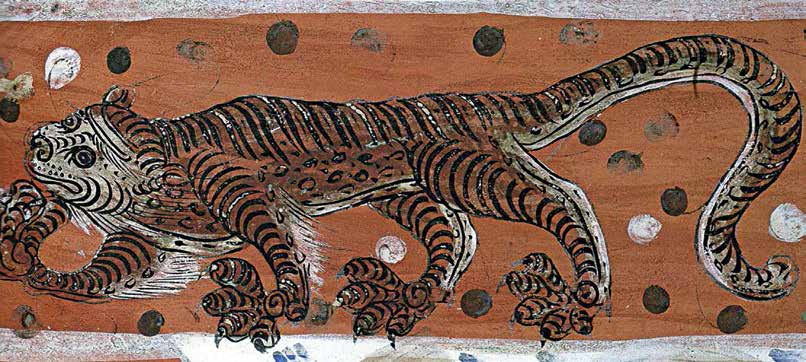
I heard a Zen story the other day that compelled me to write this essay. It was about a monk who decided to retreat to a cave in China, where he would live out the rest of his days. He was an artist, and for years his only activity, besides meditation, was painting a tiger on one of the cave walls. The work was so meticulous, so perfect, that when he finally completed it and stood before it in contemplation, he felt fear.
The story made me reflect on how, sometimes, we create our own illusions, our own expectations — and how they can frighten us when they become real, or seem to.
Cut to today. After many years, I felt fear again. Not the fear of a painted tiger, but the fear that rises when we confront the fragility of life, the wearing down of the body, the relentless passage of time.
I have always enjoyed enviable health. In nearly 64 years, very few medical episodes have marked my path. The most serious, if I can even call it that, was surgery to remove my gallbladder — laparoscopic, three small holes in the abdomen. I walked in and out of the hospital the same day, as if nothing had happened.
Over the years, a bout of shingles hit me shortly after my father’s death. Perhaps that explains it: the low immunity born of my tendency to relativize pain and suffering, to avoid confronting them head-on. I remember a phrase my father used to say: “I don’t want a wake.” At the time, I clung to that idea as a way to accelerate grief and minimize my own suffering. But the bill arrived months later, when the shingles appeared. What resists, persists — as some barroom philosopher once said.
After that, a few bouts of the flu, one possible Covid (I’m not certain — the test was inconclusive), and nothing more. Until then, my health seemed an impregnable fortress. But this week, visiting the ophthalmologist, I received the news that I will soon need cataract surgery. My mother, who turned 90 on February 10th, never needed glasses — only recently, for reading. I thought I had inherited her luck in that regard. But the reality is that for some time now I have been noticing difficulty reading.
I write my texts originally on a typewriter, then transfer them to a digital file, which I edit on the computer. Each time I go through this process, the sharpness of the letters seems to slip away — as if all those characters were slowly fusing into one another.
The fear that came over me is not about the surgery itself. From what people tell me, it is a nearly routine procedure these days.
My struggle is with accepting the natural deterioration of the body, the gradual diminishment of vitality and physical strength. Mentally, I feel I still have agility — that my mind holds its own against time. But the body is not so forgiving. It signals, little by little, that the flow of life cannot be ignored. And that is where fear tries to settle in: in the acceptance that other signals will come, that aging is an inexorable process.
Every day I practice trying not to paint the tiger. That is, not to build unrealistic expectations, not to imagine ideal scenarios and then cling to them as if they were the only truth. Everyone speaks of hope — that things will unfold in a way that gives us enough time to avoid despair. But hope, that troublesome little word, which is nothing more than fear in disguise, is merely the other side of the same illusory coin. Whoever lives without hope also lives without fear.
There is no hope without fear, nor fear without hope. — Baruch Spinoza
The Danish writer Isak Dinesen has a crystalline phrase: the secret lies in dealing with the situation without hope and without despair. Accepting what life presents, because at bottom there is no alternative. We are not absolute agents of our destiny, but part of a greater Consciousness — which sages and philosophers across millennia have held to be perfect in its imperfection.
And so I demand of myself that I stop painting tigers. Not to create illusions that, in the end, only exist to frighten me. Life is what it is, and fear, however much it tries to disguise itself as hope or despair, is simply a sign that we are alive — that we still care, that we are still here, facing the natural flow of things.
And so I go on, trying not to paint tigers, but no longer afraid to face the ones already there, ready to remind me to pay attention to what is real: the beauty of being alive now, in this very (and only) moment.